
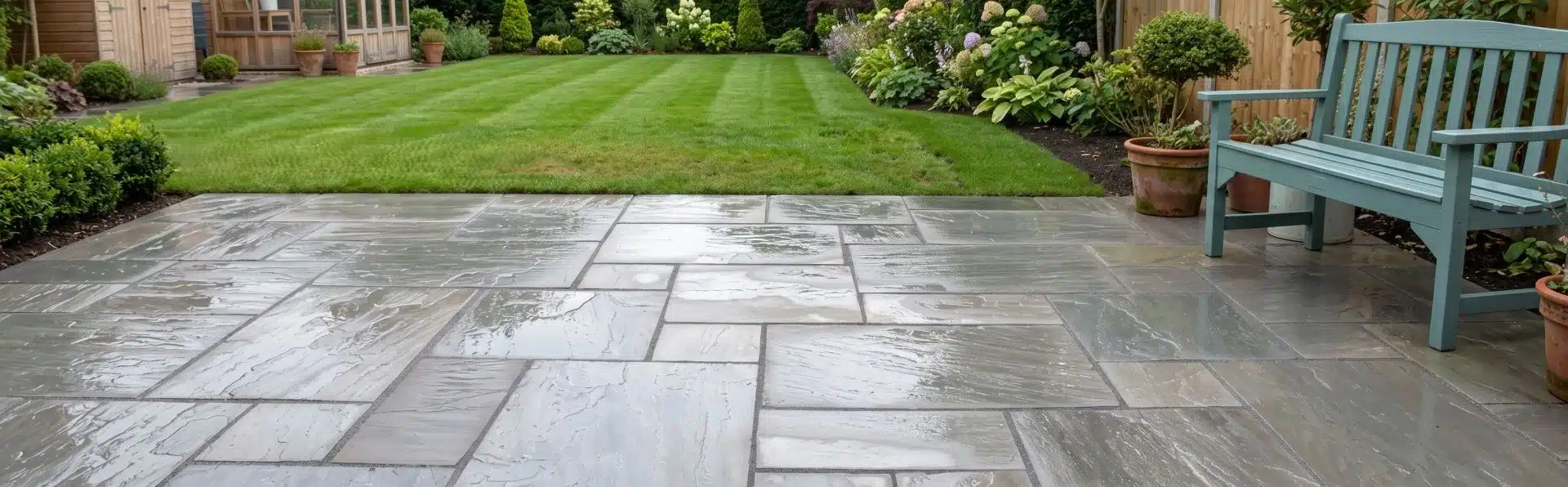
Calibrated Sandstone: Why 22mm Is the Trade Standard
Calibration is one of those terms that gets used constantly in the stone trade, but rarely explained. For merchants stocking sandstone and the landscapers buying it from you, understanding what calibration actually does — and why Pave World builds every load around it — makes for a much easier conversation on the yard floor.
What Calibration Means
Sandstone is a natural material, and no two blocks quarried from the earth are perfectly uniform. Left uncalibrated, slabs vary in thickness from piece to piece, which means an installer has to judge and adjust the mortar bed under every single stone to keep a patio or driveway level.
Calibration solves this at source. It’s a mechanical process that brings every slab to a consistent thickness before it ever reaches site, so the guesswork is engineered out of the product rather than left to the installer.
How It’s Done
The process is known in the industry as strip milling. Slabs pass through a bank of diamond-edged blades set at a precise, uniform height, cutting a series of grooves into the underside of the stone. Once milled, the ridged sections are chiselled away, leaving a flag of even thickness across the full slab. It’s a demanding process — sandstone is hard, and holding tolerance across a whole batch takes properly set-up machinery and an experienced operator.
Why It Matters On Site
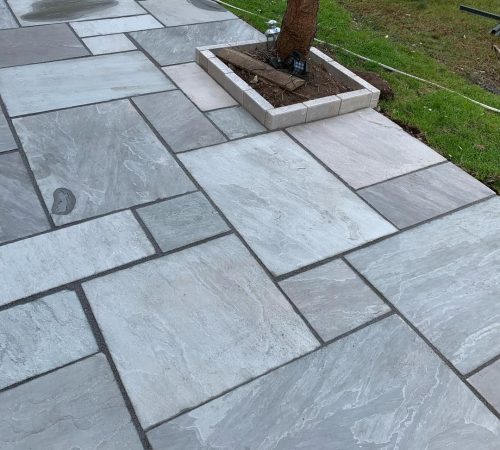
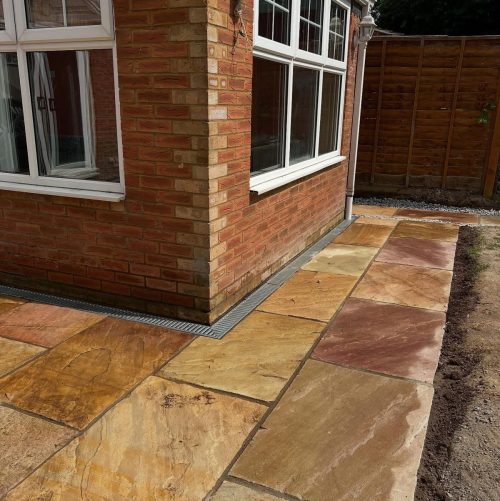
For landscapers, calibrated stone is the difference between laying to a rhythm and laying to a puzzle. With uniform thickness, there’s no need to build up or thin down the mortar bed to compensate for one slab being fatter than the next — the bed depth stays consistent, the surface comes out flat, and the job moves faster. That’s less time per square metre, less wasted cutting, and a cleaner finish to hand over.
Why It Matters for Loads
Calibration also changes what fits in a container. Thinner, tightly tolerances stone stacks more efficiently than slabs left at their natural, variable thickness — which is exactly why 22mm has become the trade benchmark. It’s the sweet spot between coverage per load and performance underfoot, letting merchants get more usable stone per container and per delivery without compromising on how the stone performs once it’s down.
Strength, Sub-Base and Specification
Thickness isn’t just about logistics — it’s about specification. Properly bedded on a full mortar bed over a well-compacted sub-base, 22mm calibrated sandstone comfortably handles the loads seen on patios, pathways, and the vast majority of domestic driveways. A few specification points worth keeping in mind for any calibrated lay:
- Sub-base: a well-compacted MOT Type 1 (or equivalent) base to the relevant project spec, every time.
- Setting bed: a flexible sand/cement bed or semi-rigid system, chosen to suit the project.
- Bedding and joints: consistent joint width, using a recommended bedding mix, keeps both appearance and performance on point.
- Cutting: diamond blade saws for sawn edges; riven flags handled with a bit more care to avoid breakage at the edge.
- Sealing: an optional finishing step — always worth testing on a sample first, since it can change both appearance and ongoing maintenance.
For higher-traffic applications, particularly with softer stone types, stepping up to a thicker calibration adds meaningful extra strength — worth flagging to customers speccing anything with regular vehicle movement.
Cutting Tolerance
Even calibrated stone carries a permissible variation, known as cutting tolerance. On hard sandstones like Kandla Grey Sandstone Paving, the large calibrating wheels used across the industry typically hold tolerance to within +/-2mm — tight enough for a professional, consistent lay every time, while respecting that this is still a natural product, not a manufactured one.
Every Product, 22mm Calibrated
This isn’t a spec that applies to one or two lines — it’s how the whole Pave World sandstone range is built. Whatever tone or finish a customer is after, it lands at the same consistent 22mm calibration:
- Raj Green
- Kandla Grey Sandstone paving and Kandla Blend Sandstone
- Autumn Brown
- Rippon Buff
- Modak Rose
- Raveena
- Slate Grey
- Mint Fossil
- Kotah Blue
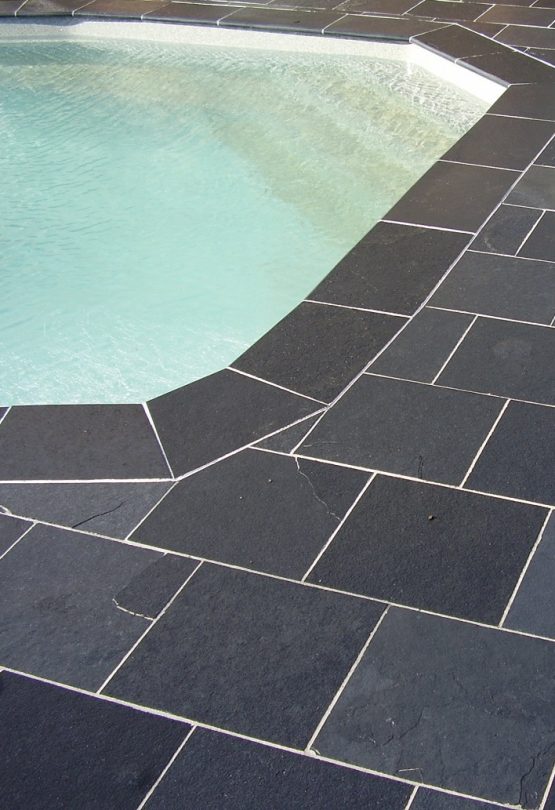
- Black Lime
- Grey Lime and Yellow Lime
That breadth means merchants can offer customers a genuine choice of colour and character — golden buffs, cool greys, warm pinks, multi-blend tones — without ever having to explain away an inconsistent thickness on the pallet.
Trade Support Around the Product
Calibration is only part of what makes a load easy to sell and easy to lay. Alongside consistent thickness, Pave World backs every range with:
- Sample kits so customers can confirm colour and finish before committing to a full order.
- Bespoke cutting, including radii, medallions and circle kits, for projects that need something beyond a standard flag.
- Palletised, nationwide delivery with clear unit counts, so what lands on site matches what was quoted.
- Trade quotes and account support, built around project size and delivery postcode rather than a one-size-fits-all price list.
Every Pallet, Every Load
The entire range of Pave World sandstone paving is calibrated to 22mm as standard, across every full load, mixed load, and yard delivery. That means merchants can spec with confidence, sell with confidence, and know exactly what’s landing before the container’s even scheduled.
Get in touch with the team to talk through container scheduling and load options for your next stock order by emailing us at info@paveworld.co.uk
Frequently Asked Questions (FAQs)
Patios, garden paths, steps, and most domestic driveways — 22mm is the standard specification for the majority of residential and light commercial hardscapes.
No — calibration is a thickness process carried out on the underside of the slab. The face, texture, and finish (riven, sawn, or brushed) are unaffected.
Yes, within a small cutting tolerance — typically +/-2mm on hard sandstones. This is normal for a natural material and doesn’t affect the lay.
For the majority of domestic driveways, yes, provided it’s laid on a full mortar bed over a properly compacted sub-base. For heavier vehicle traffic or softer stone types, a thicker calibration is worth considering.
Yes — every sandstone line in the range, across every colour and finish, is calibrated to 22mm as standard.